Math
How to Help Your Child Learn Their Math Facts
Knowing 8 + 7 or 6 × 7 without counting frees your child’s mind for the harder math that comes next. Here’s when schools expect it, and how to help at home in a few minutes a day.

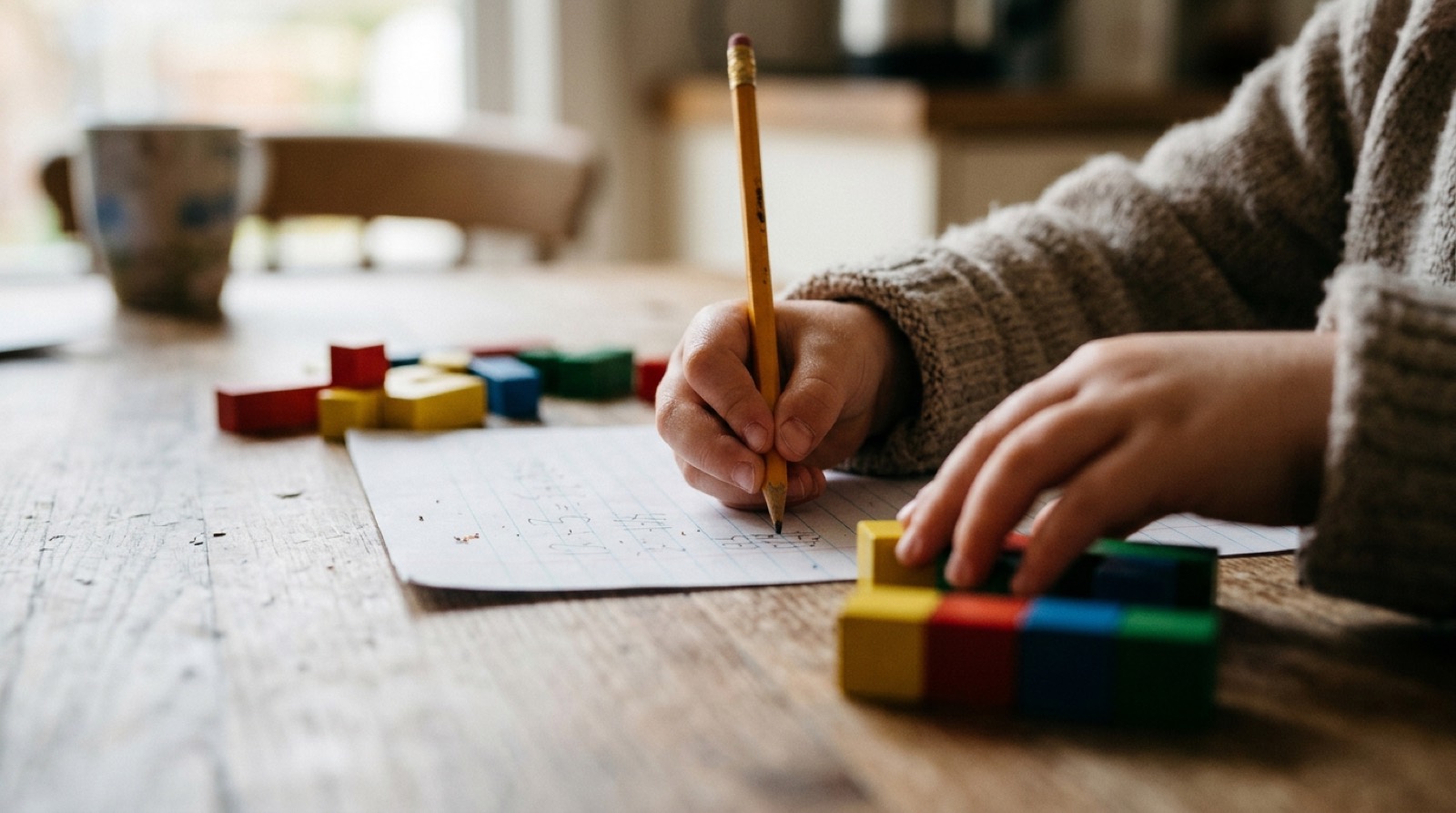
Why does knowing math facts by heart matter?
A child who has to count on their fingers for 8 + 7 uses all their attention on that one step, and loses track of the bigger problem: the carrying, the word problem, the fraction. Once facts are automatic, answered in a second or two without counting, there’s room left to think about the harder math.
When should kids know their math facts?
Common Core expects sums and differences within 5 by the end of Kindergarten, and within 10 by the end of Grade 1. By the end of Grade 2, children should know every sum of two one-digit numbers. By the end of Grade 3, they should know every times-table fact by heart.
| By the end of | Know by heart (Common Core) |
|---|---|
| Kindergarten | Sums and differences within 5 |
| Grade 1 | Sums and differences within 10 |
| Grade 2 | Every sum of two one-digit numbers (within 20) |
| Grade 3 | Every product of two one-digit numbers (the times tables) |
Ask your child’s teacher which facts the class is working on right now. That’s the best set to practice at home.
What strategies help kids learn math facts?
Facts stick better when children see how they connect, so teach a strategy before memorizing. Making a ten, doubles and near doubles, taking from the ten, turning a fact around, and building on a fact they know are taught in many classrooms. They turn the hardest facts into easy steps.
- Make a ten: 8 + 7 → 8 + 2 is 10, plus 5 more is 15.
- Doubles and near doubles: 6 + 6 = 12, so 6 + 7 is one more, 13.
- Take from the ten: 15 − 8 → 15 is 5 and 10; 10 − 8 is 2; 5 + 2 is 7.
- Turn it around: 3 × 8 is the same as 8 × 3.
- Use a fact you know: 6 × 7 is 5 × 7 (35) plus one more 7: 42.
How should kids practice math facts at home?
Practice for 5–10 minutes a day rather than an hour once a week. Work on a few facts at a time, mixing in ones your child already knows, and add new ones as the old ones become easy. Ask facts in the car or at dinner, and watch for speed as well as right answers.
- 5–10 minutes a day beats an hour once a week.
- A few facts at a time. Add new ones as the old ones become easy.
- Mix in the ones they know. Easy wins keep it positive and keep old facts fresh.
- Say them in the car or at dinner. “What’s 7 + 6?” takes ten seconds.
- Watch speed, not just right answers. “By heart” means answering in a second or two, without counting.
Quick questions
Is it bad if my child counts on their fingers?
Not at first. Fingers are a great tool in Kindergarten and Grade 1. Strategies and regular practice help children move beyond them by Grades 2–3.
Are timed tests good for learning facts?
Speed matters, but pressure doesn’t help everyone. Short, regular practice where children compete only with their own last time works well for most kids.
Which times tables should we learn first?
Most children start with the 2s, 5s and 10s, then 3s and 4s, then the harder 6s, 7s, 8s and 9s.
How do I know when a fact is learned?
When your child answers it in a second or two without counting, on more than one day. Keep mixing it in now and then so it stays fresh.