Routines
A Daily Homeschool Schedule for Kids 4–10 (With Sample Days)
The best homeschool schedule is the one you can keep every day. Here are sample days for ages 4–5, 6–8 and 9–10, plus how long lessons should be and how to juggle more than one child.

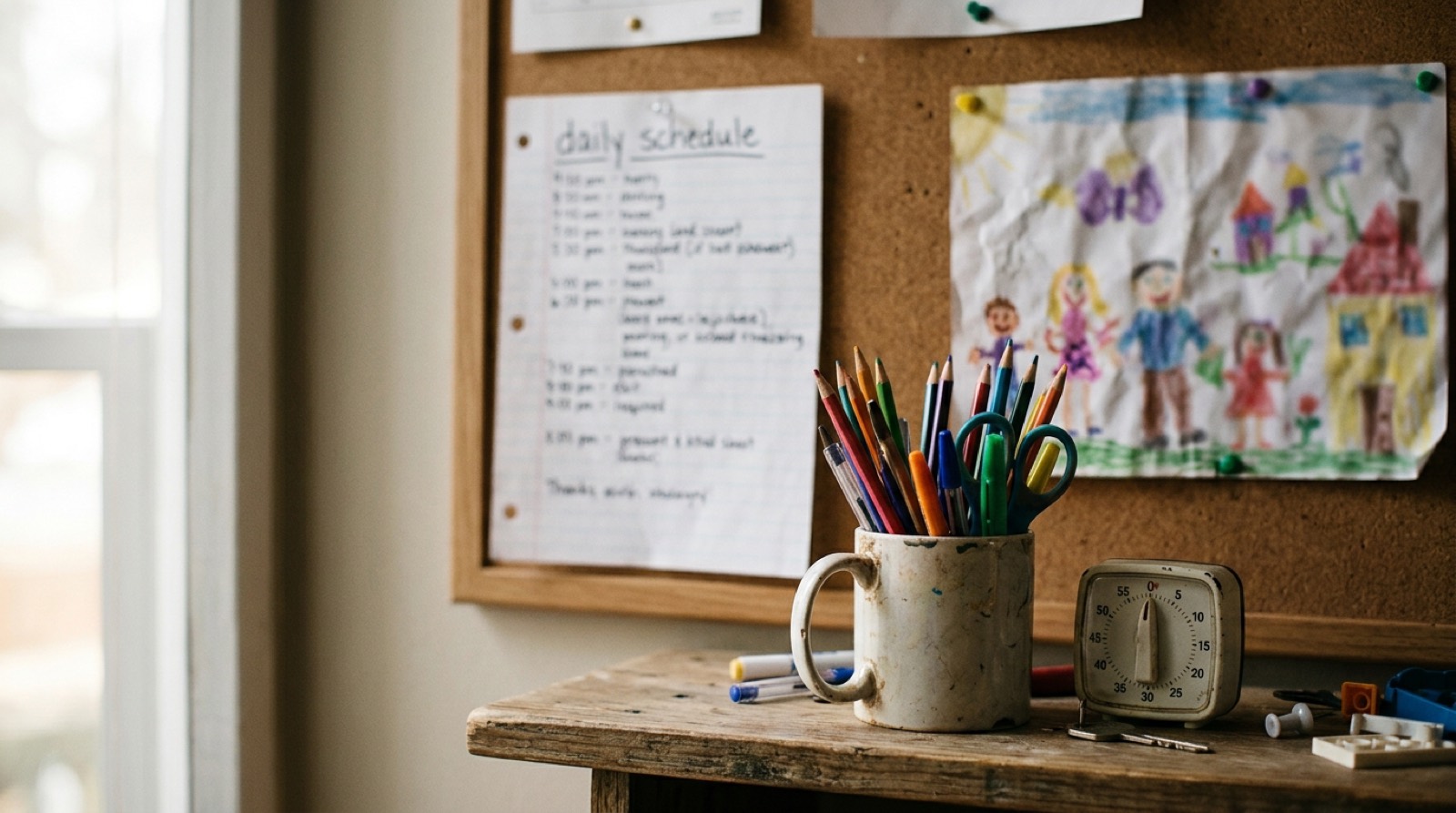
Should a homeschool day follow a strict timetable?
No. Young children do best with the same order every day (breakfast, lessons, outside, lunch, reading) rather than exact times. A routine means less arguing about “what now?”, and children start to settle into lessons without being asked. Do the hardest focused work first, usually math and reading in the morning.
Math and reading go first because attention is freshest then. Save projects, art, nature and outings for later in the day.
How long should lessons be?
Focused lessons should be about 10–15 minutes per subject for ages 4–5, 15–25 minutes for ages 6–8, and 25–40 minutes for ages 9–10. That adds up to roughly 45–90 minutes of focused learning a day at 4–5, 1½–2½ hours at 6–8, and 2½–3½ hours at 9–10.
| Age | Focused work per subject | Total focused learning a day |
|---|---|---|
| 4–5 | 10–15 minutes | About 45–90 minutes |
| 6–8 | 15–25 minutes | About 1½–2½ hours |
| 9–10 | 25–40 minutes | About 2½–3½ hours |
These are starting points. Watch your child: stop while it’s still going well, and lengthen lessons a little at a time. Reading together, play, cooking and outings are learning too, on top of these numbers.
What does a homeschool day look like for a 4- or 5-year-old?
For ages 4–5 (pre-K and Kindergarten), a morning can hold two short lessons, letters and sounds and then math, each 10–15 minutes, with a movement break between them. Add a read-aloud on the couch, plenty of play outdoors, and drawing, art or music before lunch. Afternoons are free play, outings and rest.
| Time | What |
|---|---|
| 8:30 | Breakfast, get dressed, a quick tidy-up (chores are part of the routine) |
| 9:00 | Letters and sounds: 10–15 minutes |
| 9:15 | Movement break: dance, jump, run outside |
| 9:30 | Math: counting, comparing, adding within 10 (10–15 minutes) |
| 9:45 | Read-aloud on the couch: picture books, then talk about the story |
| 10:15 | Play, outdoors if possible |
| 11:30 | Tracing letters or drawing; art, music or a simple science activity |
| Afternoon | Free play, outings, library, rest |
What does a homeschool day look like for ages 6–8?
For ages 6–8 (Grades 1–3), start with 20 minutes of math, then 15–20 minutes of your child reading aloud. After a snack and a movement break, do 15 minutes of spelling and phonics, a few sentences of writing, then science or history. Afternoons are for quiet reading, projects, sports and friends.
| Time | What |
|---|---|
| 8:30 | Breakfast and morning tasks: brush teeth, make the bed, pack away toys |
| 9:00 | Math: 20 minutes (new idea, then practice) |
| 9:20 | Reading aloud: your child reads to you (or the app listens) for 15–20 minutes |
| 9:40 | Snack and a movement break |
| 10:00 | Spelling and phonics: 15 minutes |
| 10:15 | Writing: a few sentences about something real, with capital letters and periods |
| 10:45 | Science or history: a library book, video or experiment |
| Afternoon | Quiet reading time, projects, sport, friends |
What does a homeschool day look like for ages 9–10?
For ages 9–10 (Grades 4–5), math gets 30–40 minutes first thing. After a break comes a chapter book read alone and talked about, a paragraph of writing proofread together, and 15–20 minutes of spelling and grammar. Then science, history or a longer project. Afternoons follow interests: music, coding, sports, art or field trips.
| Time | What |
|---|---|
| 8:30 | Morning tasks and a plan for the day (let them tick it off) |
| 9:00 | Math: 30–40 minutes (fractions, decimals, multi-digit work) |
| 9:40 | Break |
| 9:55 | Reading: a chapter book on their own, then talk about it or answer a few questions |
| 10:30 | Writing: a paragraph or short piece, then proofread it together |
| 11:00 | Spelling and grammar: 15–20 minutes |
| 11:20 | Science, history or a longer project |
| Afternoon | Interests: music, coding, sport, art, volunteering, field trips |
How do you homeschool more than one child at once?
Stagger the one-to-one work: teach one child a new idea while the other does practice they can manage alone, then swap. Teach read-alouds, science, history, art and music together, expecting more from the older child. Self-guided practice, like an app that reads questions aloud, frees you to work with one child at a time.
- Stagger the one-to-one work. While you teach one child a new math idea, the other does practice they can manage alone, then swap.
- Teach some subjects together. Read-alouds, science, history, art and music work across ages; just expect more from the older child.
- Use self-guided practice. An app that reads questions aloud and explains mistakes lets a younger child practice while you work with an older one.
How do I make a homeschool schedule stick?
Keep the same order every day, so children settle in without being asked. Put lessons first, and games, screens and treats after. Praise progress against your child’s own last week, not against other children. And plan rest days: four or five lesson days a week is plenty for young children.
- Same order, every day. Children start to settle in without being asked.
- Lessons first, then fun. Games, screens and treats after the day’s lessons, not mixed into them.
- Praise real progress. Compare your child with their own last week, not with other children.
- Plan rest days. Four or five lesson days a week is plenty for young children; use the others for outings and play.
Quick questions
How many days a week should I homeschool?
Most families do four or five days a week. Some states set a minimum number of days a year (often around 180), so check your state’s rules.
What should I teach first in the morning?
The subject that needs the most focus, usually math, then reading. Save hands-on and creative work for later in the day.
Should a homeschool schedule include chores?
Yes. Short daily tasks like making the bed or tidying toys build the same habits as lessons, and fit naturally into a morning routine.
What if we fall behind the schedule?
Pick up where you left off. A sample day is a starting point, not a deadline, and keeping the routine going most days matters more than any single day.