Math
Homeschool Math, K–5: What to Teach in Each Grade
Math builds like a staircase: each step needs the one before. Here’s what to teach in each grade from Kindergarten to Grade 5, following the Common Core standards most US schools use.

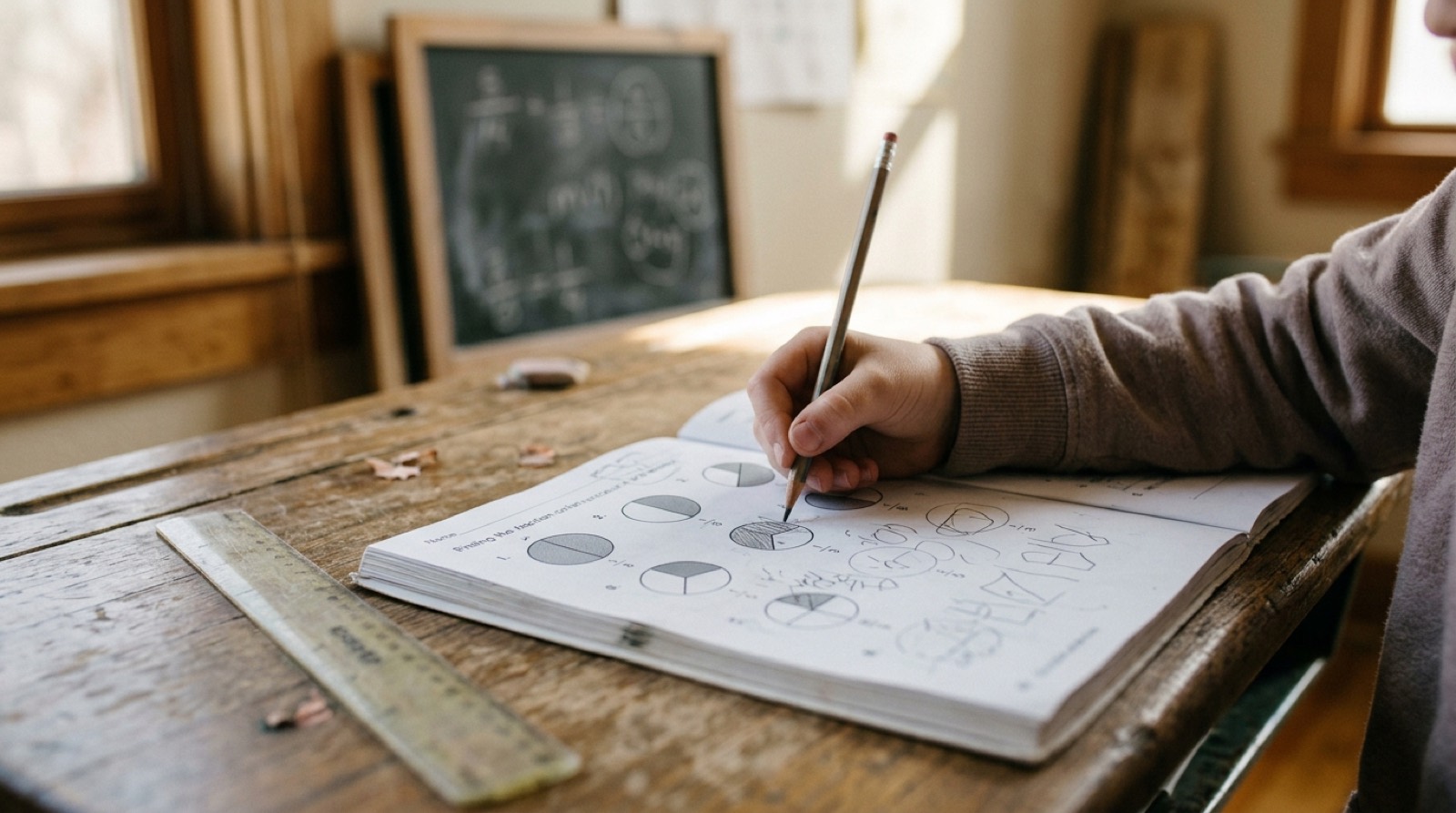
This plan follows the Common Core math standards, so your child stays on track with US schools and state tests. Treat the grades as a sequence, not a deadline: a child who’s ready can move faster, and one who needs more time can take it.
What math should be taught in Kindergarten?
Kindergarten math is about counting and small numbers. Children learn to count to 100 by ones and tens, count objects, write numbers 0–20 and compare groups. They add and subtract within 10 with objects, know sums within 5 quickly, see teen numbers as ten and some more, and name flat and solid shapes.
- Count to 100 by ones and by tens; count a group of objects and tell how many.
- Write numbers 0–20; compare two groups (more, fewer, equal).
- Add and subtract within 10 with objects and pictures; know sums within 5 quickly.
- Teen numbers as ten and some more (14 is 10 and 4).
- Name flat and solid shapes; compare length and weight.
Tip: use real objects (blocks, buttons, snacks) before pictures, and pictures before numbers alone.
What math should be taught in Grade 1?
Grade 1 math centers on adding and subtracting within 20, using strategies like making a ten, with sums within 10 known by heart. Children learn tens and ones, count to 120 and compare two-digit numbers. They also measure length, tell time to the half hour, read simple graphs and split shapes into halves and quarters.
- Add and subtract within 20, using strategies like making a ten and counting on; know sums within 10 by heart.
- Place value: tens and ones; count to 120; compare two-digit numbers.
- Add a two-digit number and a one-digit number, or a multiple of ten.
- Measure length with units; tell time to the hour and half hour; read simple graphs.
- Split shapes into halves and quarters.
What math should be taught in Grade 2?
In Grade 2, children should come to know every sum of two one-digit numbers by heart. They add and subtract within 100 fluently and within 1,000 with regrouping, learn place value to 1,000, and skip-count. They measure in inches and centimeters, count money, tell time to 5 minutes, and use arrays as groundwork for multiplication.
- Know all sums of two one-digit numbers by heart, and add and subtract within 20 quickly.
- Add and subtract within 100 fluently, and within 1,000, including regrouping (“carrying” and “borrowing”).
- Place value to 1,000; skip-count by 5s, 10s and 100s.
- Measure in inches, feet, centimeters and meters; money; time to 5 minutes; bar graphs and line plots.
- Equal rows (arrays) and odd and even numbers: the groundwork for multiplication.
Tip: the jump to knowing facts by heart matters. Short, daily practice beats long, occasional sessions.
What math should be taught in Grade 3?
Grade 3 math is the year of multiplication and division within 100, with every times-table fact known by heart. Children solve two-step word problems, place fractions on a number line and compare them, find area and perimeter, tell time to the minute, and round to the nearest 10 and 100.
- Multiplication and division within 100; know all products of two one-digit numbers by heart.
- Two-step word problems with all four operations.
- Fractions: unit fractions, fractions on a number line, equal fractions, comparing fractions.
- Area (counting squares, then length × width) and perimeter.
- Time to the minute and elapsed time; rounding to the nearest 10 and 100.
What math should be taught in Grade 4?
Grade 4 math moves to multi-digit work: multiplying up to four digits by one digit and two digits by two, and dividing with remainders. Children learn factors, multiples and primes, equal fractions, adding and subtracting fractions with the same denominator, decimals to hundredths, and measuring angles with a protractor.
- Multiply up to four digits by one digit, and two digits by two digits; divide up to four digits by one digit, with remainders.
- Factors, multiples and prime numbers.
- Equal fractions; add and subtract fractions with the same denominator; mixed numbers; multiply a fraction by a whole number.
- Decimals to hundredths; compare decimals.
- Angles (measure with a protractor), lines and shapes; converting units.
What math should be taught in Grade 5?
Grade 5 math covers place value to thousandths and all four operations with decimals to hundredths. Children add and subtract fractions with different denominators, multiply fractions and divide with unit fractions. They divide by two-digit numbers, and learn volume, the coordinate plane, powers of ten and simple expressions with brackets.
- Place value to thousandths; add, subtract, multiply and divide decimals to hundredths.
- Add and subtract fractions with different denominators; multiply fractions; divide with unit fractions.
- Multi-digit multiplication and division by two-digit numbers.
- Volume; the coordinate plane; powers of ten and simple expressions with brackets.
How do you teach homeschool math well?
Show why a method works with objects or a drawing, then teach the quick way. Walk through mistakes step by step right away, so the wrong way doesn’t stick. Move on only once a skill is accurate and reasonably quick on more than one day, and practice for 15–30 minutes every day.
- Understand first, then practice. Show why it works (with objects or a drawing), then the quick way.
- Fix mistakes right away. Walk through a wrong answer step by step, so the wrong way doesn’t stick.
- Move on once it’s mastered. Accurate and reasonably quick, on more than one day, not just “we did that page”.
- Little and often. 15–30 minutes every day beats two long sessions a week.
- Compare with last week, not with other children. Steady progress is the goal.
Quick questions
What math should a 5-year-old know?
By the end of Kindergarten: counting to 100, counting objects, comparing groups, adding and subtracting within 10, and knowing sums within 5 quickly. Many 5-year-olds are still working on these, and that’s fine.
When should my child know their addition facts by heart?
Common Core expects every sum of two one-digit numbers to be known from memory by the end of Grade 2, and every times-table fact by the end of Grade 3.
Should I let my child use fingers to count?
Yes, early on. Fingers are a great tool in Kindergarten and Grade 1. Over time, strategies like making a ten and plenty of practice help children move to knowing facts by heart.
Do I have to follow the grades exactly?
No. Treat the grades as a sequence, not a deadline. A child who’s ready can move faster, and one who needs more time can take it.
How long should a homeschool math lesson be?
About 15–30 minutes a day for most children K–5. Short daily practice beats long, occasional sessions.